

Welcome!
You're in the Right Place
If you're wondering,
“Can this really work for me?”—you're not alone.
Here you'll discover real-life journeys from soul-led creators who've courageously transformed fear into clarity, overwhelm into confidence, and doubt into joyful action.
Let these heartfelt testimonials inspire you. They're proof your transformation is truly possible.
I'm so glad you're here.
Welcome! You're in the
Right Place
If you're wondering,
“Can this really work for me?”—you're not alone.
Here you'll discover real-life journeys from soul-led creators who've courageously transformed fear into clarity, overwhelm into confidence, and doubt into joyful action.
Let these heartfelt testimonials inspire you. They're proof your transformation is truly possible.
I'm so glad you're here.
Client Stories
Real People, Real Transformations

“For years, I could show compassion to others—but not to myself. With Pennie’s support, I’ve finally learned that being okay with where I am, even in the messy moments, is real progress. That shift changed everything.”
Charlene ~Retired Nurse, Side Business Extraordinaire

“My very first session unearthed hidden childhood fears I didn’t even know were there—and showed me a path to true forgiveness. I discovered powerful visualization that set me free and ignited my journey of self-trust.”
Jeff ~Artist
“Imagine your fears transforming into protective dragon scales—could that simple image unlock your deepest sense of safety? Watch the clip to see how this vivid metaphor became Zade’s pivotal turning point.”
Zade ~Creator learning to use his voice
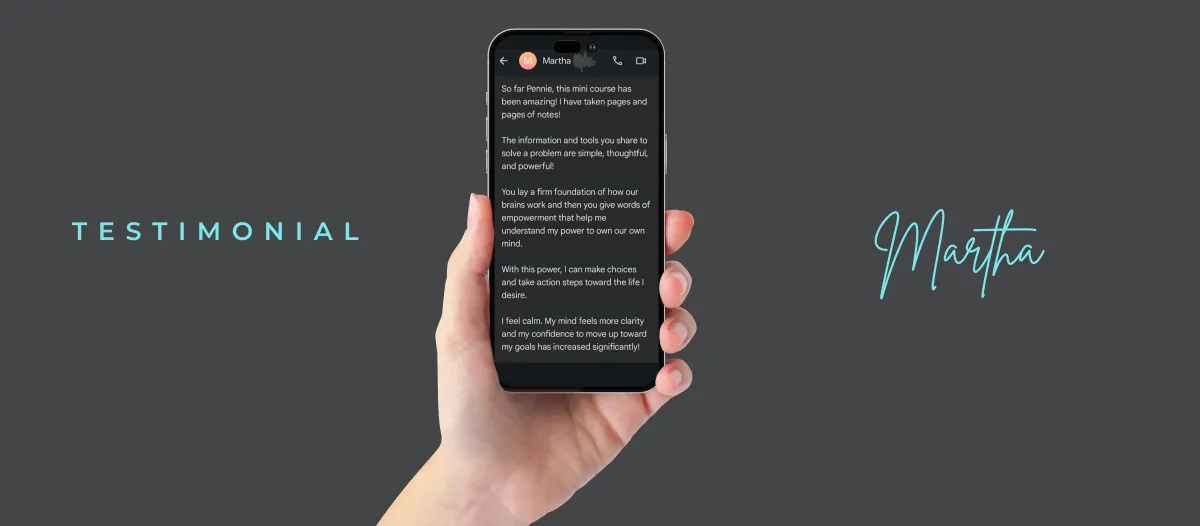
“Turning 50 felt like standing at the bottom of a mountain. But with Pennie’s guidance, I’ve learned to see the climb as part of becoming. I’m not afraid of the messy middle anymore—I’m growing through it.”
Martha ~Thought Cards Creator marthamovesup.com




The Power of Hypnotherapy
Older Testimonials Over The Years
From Stuck to Empowered
"I used to be stuck in a place where most people would never want to go and I allowed it to define who I was. This process has opened up my eyes to set boundaries in my relationships. I am ready to step into my personal power!"

– G. B.
Deeper Than Words
"Group Hypno has been surprisingly helpful to me. Some of what I feel I need to process is so deep that I don’t have words to talk about it directly with anyone. Group Hypno removes some of the roadblocks for me."
– P. V.
Crisis to Calm
"I was skeptical at first but almost immediately I felt peace and calm from within. I felt like I could think clearer and I could TRUST my gut over my anxiety. The process guided me to discover the solutions that I needed inside myself and I gained a sense of internal empowerment."
– R. T.
Feeling the FLOW
"I loved that you used universal language to include people of any faith. I also loved the light healing visualizations! I also was able to achieve my desired intention to have more confidence in my musical performance going from a 4 to an 8 on a scale of 1-10, which is super awesome."
– A. D.
Letting Go of Abandonment
"There was one session specifically that helped me recognize the loss I felt of what might have been from being adopted at birth. During the Group session, I was able to grieve that fear and let go of the feeling of abandonment that I have struggled with my whole life."
– A. D.
The Person Behind of all this Client Victories!
Cheering on Your Victory
Pennie Wilson:
Phoenix-Hearted Mentor &
Mental Fitness Coach
Why This Works:
Eighteen years ago I was a homeschooling mom of five—depressed, burnt out, and convinced I was not worth the effort to live my purpose.
Rock bottom became my turning point.
Through a divinely led path, I discovered meditation, subconscious rewiring, and grace and relentless self-leadership, I rose.
Today I guide soul-led creators to do the same: integrate mind, body, heart, and spirit (Kokoro).
My promise? Practical tools rooted in love that transform fear into focused, joyful action.

Pennie Wilson:
Phoenix-Hearted Mentor &
Mental Fitness Coach
Why This Works:
Eighteen years ago I was a homeschooling mom of five—depressed, burnt out, and convinced I was not worth the effort to live my purpose.
Rock bottom became my turning point.
Through a divinely led path, I discovered meditation, subconscious rewiring, and grace and relentless self-leadership, I rose.
Today I guide soul-led creators to do the same: integrate mind, body, heart, and spirit (Kokoro).
My promise? Practical tools rooted in love that transform fear into focused, joyful action.
Read More About Pennie Written Blogs:

Why Calm Disappears Under Pressure
Why Calm Disappears Under Pressure
| Mental Fitness Trainer Insight

Why You Can Stay Calm… Until It Actually Matters
You probably already know how to stay calm… until you’re in a stressful situation and it matters most.
Calm disappears under pressure because the brain shifts into a stress response, prioritizing fast reactions over clear thinking. When calm has not been practiced in advance, the system defaults to familiar reactive patterns instead of steady responses.
Why Does Calm Disappear Under Pressure?
Many high-functioning people are able to stay calm in normal conditions. When things are predictable and manageable, you can think clearly, communicate effectively, and follow through on what matters. In those moments, calm feels natural and accessible.
However, this experience often changes when pressure increases.
Research in neuroscience shows that under stress, clear thinking decreases while reactive systems become more dominant. This shift prioritizes speed and immediate response rather than reflection.
Additional research on threat processing shows that the brain can begin reacting before conscious awareness fully engages.
This helps explain a common experience:
You can know how to stay calm, and still feel like that calm disappears when pressure increases.
How to Stay Calm Under Pressure in Stressful Situations
Understanding why calm disappears is helpful, but most people are really trying to answer a different question: how do I actually stay calm when it matters?
The answer is not found in trying harder during the moment.
When pressure is already high, your system does not respond to what you are trying to remember.
It responds to what it already recognizes as familiar.
This is why techniques that rely on thinking in the moment often feel unreliable.
Calm must be trained in advance, not created on demand.
A Real Experience High-Functioning People Don’t Talk About
Throughout your day, you may move through your responsibilities with clarity and consistency. You make decisions, respond to others, and handle what needs to be handled without becoming overwhelmed.
However, when pressure increases, the internal experience begins to change.
Your thoughts may begin to move more quickly, your body may hold tension without you fully noticing it, and conversations that would normally feel manageable begin to feel more reactive.
Later, when the situation settles, clarity returns. You can see exactly how you would have preferred to respond.
If you know how to stay calm, why didn’t that show up when it mattered?
This is not a lack of awareness or ability. It is how your system has been conditioned to respond.
The Real Mechanism: Training Calm Before the Moment
To understand how to change this, it helps to look at how the brain learns and stores patterns.
When you are in a calm and relaxed state, your mind is more receptive. This is where new patterns can be formed more effectively.
When you intentionally imagine yourself responding calmly in situations that would normally create pressure, you begin to build a mental and emotional reference for that response.
This is not just thinking about staying calm. It is experiencing it internally.
Over time, this creates a sense of familiarity in the brain.
When the real situation occurs, your system does not have to figure out what to do.
It follows what it has already practiced.
Instead of asking, “What should I do here?”
Your brain responds with, “I’ve been here before.”
Why Calm Breaks Under Stress (And What It Really Means)
When people say they lose calm under pressure, what is actually happening is that their system is returning to the most familiar pattern it knows in that state.
If the only familiar pattern is reacting quickly, overthinking, or bracing internally, that is what will appear automatically.
This is why knowledge alone is not enough.
You may understand exactly how you want to respond, but if your system has not practiced that response in advance, it will default to what it already recognizes.
The gap is not between knowing and doing.
The gap is between knowing and what your system has practiced.
Mental Fitness Trainer Perspective: Calm That Holds Under Pressure
From a Mental Fitness Trainer perspective, calm is not something you try to access in the moment.
It is something you train into your system before the moment happens.
Mental fitness focuses on practicing calm in a relaxed state while intentionally imagining how you want to respond under pressure.
This creates familiarity that carries into real situations.
Over time, your real-life responses begin to shift—not because you are forcing change in the moment, but because your system recognizes a new way of responding as normal.
A Simple Way to Begin
You can begin this process by setting aside a few minutes in a calm and quiet environment.
Allow your body to relax, and then bring to mind a situation that would normally create pressure.
Instead of analyzing it, imagine yourself moving through it with steadiness.
Notice what you want to think, how you would speak, and how you would carry yourself.
Let yourself feel what that version of you experiences.
This is not about getting it perfect.
It is about giving your system a reference it can recognize later.
Small Practice Creates Real Change
At first, this practice may feel subtle. You may not notice immediate shifts in how you respond in real situations, and that is part of the process.
Your system has spent years reinforcing certain patterns under pressure. These patterns are not just thoughts—they are conditioned responses that feel automatic.
Changing them requires creating a new internal experience that the brain can recognize as familiar.
This is where visualization becomes powerful when it is done intentionally.
When you are in a calm, relaxed state, your mind becomes more receptive. In this state, you can begin to create a clear internal experience of how you want to respond.
The more vividly you imagine it, the more your brain begins to register it as real.
This means going beyond thinking.
You begin to see the situation clearly.
You hear your voice.
You feel steadiness in your body.
You experience emotions like calm, clarity, or confidence.
When these elements come together, your brain begins to form a new pattern.
Research shows that the brain does not strongly distinguish between a vividly imagined experience and a real one when emotion and sensory detail are present.
This is why athletes mentally rehearse before competition.
In the same way, when you rehearse calm responses in advance,
you are creating a pathway your system can follow later.
Over time, this becomes what your system recognizes as familiar.
When a real situation arises, your brain is not encountering something new.
It is following a pattern it already knows.
Yes, change requires repetition, but it becomes significantly more efficient when training happens in a calm state rather than during stress.
The Kokoro Calm Repatterning Method™ is built on this principle.
Instead of fighting old patterns in the moment, you are building new ones in advance.
Over time, your system begins to shift. You may notice faster recovery, less reactivity, and more natural alignment with how you want to show up.
Bringing It Together
If you have been trying to understand how to stay calm when stressed, the answer is not more information.
It is training your system before the moment happens.
Your system will not default to what you know.
It will default to what it recognizes as familiar.
When calm is practiced in a relaxed state while imagining pressure,
it becomes something your system trusts and can return to when it matters most.
To Your Victory,
Pennie 💞
Mental Fitness Trainer
Kokoro Creators
Frequently Asked Questions
Why do I lose calm in stressful situations?
Because your brain shifts into a stress response and defaults to familiar patterns it has practiced.
How can I stay calm under pressure?
By practicing calm in advance in a relaxed state while mentally rehearsing real situations.
Why does calm disappear even when nothing is wrong?
Because your system is conditioned to anticipate pressure and defaults to reactive patterns.
Is staying calm a skill or something you are born with?
Definitely a skill that can be trained through repeated practice.
Continue the Journey
If this resonates with you, you may also relate to:
👉 Why you feel overwhelmed even when nothing is wrong
👉 Take the 3-Minute Kokoro Stage Quiz
https://kokorocreators.com/quiz
Sources and Research
The concepts in this article are supported by research in neuroscience and psychology exploring how the brain responds under stress and pressure.
Research from Yale University School of Medicine shows that stress reduces activity in the prefrontal cortex, the part of the brain responsible for clear thinking, decision-making, and self-control, while increasing activity in more reactive brain systems.
Research from New York University’s Center for Neural Science shows that the brain can detect and respond to potential threat before conscious awareness, meaning reactions can begin before the thinking mind has fully processed what is happening.
If you would like to explore these studies further, you can review the following sources:
• Arnsten, A.F.T. — Stress signalling pathways that impair prefrontal cortex structure and function
https://pmc.ncbi.nlm.nih.gov/articles/PMC2907136/
• LeDoux, J.E. — Rethinking the Emotional Brain
https://pmc.ncbi.nlm.nih.gov/articles/PMC4784103/
• LeDoux, J.E. — Coming to terms with fear

Transforming Mindsets From Darkness to Light
COMPANY
CUSTOMER CARE
LEGAL
FOLLOW US


Copyright 2026. Kokoro Creators. All Rights Reserved.